• Sign in
  • Sign up
Elektrine
EN
  • EN English
  • 中 中文
Log in Register
Modes
Overview Search Chat Timeline Communities Gallery Lists Friends Email Vault VPN
Back to Timeline
  • Open on mathstodon.xyz

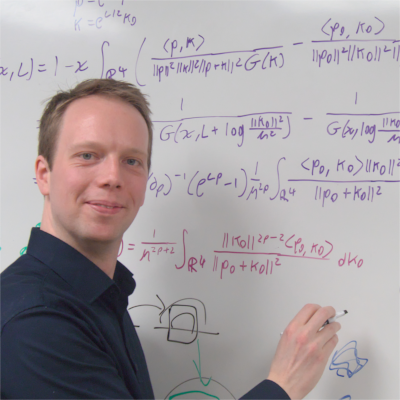
Paul Balduf

@paulbalduf@mathstodon.xyz
mastodon 4.5.7

Theoretical physicist.
Postdoc at the Mathematical Institute, University of Oxford, and research associate at St. Peter's College.
I work with Feynman graphs, combinatorics of power series, resurgence theory, and do a lot of C++ programming.
My goal is to understand the physical properties of renormalized Green functions in quantum field theory.
Has anyone seen an instanton around here lately?
#quantum #physics
#math

0 Followers
0 Following
Joined March 11, 2024
Website:
https://paulbalduf.com

Posts

paulbalduf
Paul Balduf
@paulbalduf@mathstodon.xyz

Theoretical physicist. Postdoc at the Mathematical Institute, University of Oxford, and research associate at St. Peter's College. I work with Feynman graphs, combinatorics of power series, resurgence theory, and do a lot of C++ programming. My goal is to understand the physical properties of renormalized Green functions in quantum field theory. Has anyone seen an instanton around here lately? # quantum # physics # math

mathstodon.xyz
Paul Balduf
Paul Balduf
@paulbalduf@mathstodon.xyz

Theoretical physicist. Postdoc at the Mathematical Institute, University of Oxford, and research associate at St. Peter's College. I work with Feynman graphs, combinatorics of power series, resurgence theory, and do a lot of C++ programming. My goal is to understand the physical properties of renormalized Green functions in quantum field theory. Has anyone seen an instanton around here lately? # quantum # physics # math

mathstodon.xyz
@paulbalduf@mathstodon.xyz · Mar 04, 2026

Tuesday's #paperOfTheDay is related to the one about 4-fermion coupling a few days ago. Indeed, "The equivalence of the top quark condensate and the elementary Higgs field" from 1991 essentially deals with the same setup: They consider a #quantumFieldTheory with 4-fermion interaction in 4 dimensions, which is not renormalizable by power counting, but can be treated in the leading large-N limit. The conclusion is that in this limit, the theory can be solved more or less explicitly, and its low-energy predictions are indistinguishable from having a scalar "Higgs" particle. In that scenario, whether or not the Higgs is a fundamental scalar particle is merely a question of definitions, rather than a meaningful physical one.
The leading large-N limit is not necessarily an accurate description of the full physical theory (in the same way that the first coefficient of a small-g expansion, i.e. a 1-loop calculation, is not). I would be interesting to know what the current understanding of 4-fermion interactions in 4 dimensions is, surely by now we must have many more theoretical and numerical calculations. https://www.sciencedirect.com/science/article/abs/pii/055032139190607Y

View on mathstodon.xyz
0
0
0
0
paulbalduf
Paul Balduf
@paulbalduf@mathstodon.xyz

Theoretical physicist. Postdoc at the Mathematical Institute, University of Oxford, and research associate at St. Peter's College. I work with Feynman graphs, combinatorics of power series, resurgence theory, and do a lot of C++ programming. My goal is to understand the physical properties of renormalized Green functions in quantum field theory. Has anyone seen an instanton around here lately? # quantum # physics # math

mathstodon.xyz
Paul Balduf
Paul Balduf
@paulbalduf@mathstodon.xyz

Theoretical physicist. Postdoc at the Mathematical Institute, University of Oxford, and research associate at St. Peter's College. I work with Feynman graphs, combinatorics of power series, resurgence theory, and do a lot of C++ programming. My goal is to understand the physical properties of renormalized Green functions in quantum field theory. Has anyone seen an instanton around here lately? # quantum # physics # math

mathstodon.xyz
@paulbalduf@mathstodon.xyz · Mar 02, 2026

The #paperOfTheDay is the most bizarre one I have read in the whole #dailyPaperChallenge so far: It's "Geometrisches zur Abzählung der reellen Wurzeln algebraischer Gleichungen" from 1892. It is well known that a polynomial equation of order n has exactly n complex solutions. The present article deals with the question how many of these are real: Consider for example a quadratic equation, its curve is a parabola, and a parabola can have zero, one, or two intersections with the y=0 axis. These cases can be distinguished by a calculation, without drawing the curve. More generally, in equations of higher order, these things become more involved, but Klein argues that they still correspond to concrete questions in geometry.
What is so special about this article is where it appeared: In the book "Katalog mathematischer und mathematisch-physikalischer Modelle, Apparate und Instrumente", published by the Deutsche Mathematiker-Vereinigung. That is, in 1892 the German mathematical association published a printed book about mechanical calculation devices and physical equipment, which also contained a few pure #mathematics research articles. The common theme of all this is that it is in some way related to visualization or geometric realization of mathematics.

View on mathstodon.xyz
2
0
1
0
paulbalduf
Paul Balduf
@paulbalduf@mathstodon.xyz

Theoretical physicist. Postdoc at the Mathematical Institute, University of Oxford, and research associate at St. Peter's College. I work with Feynman graphs, combinatorics of power series, resurgence theory, and do a lot of C++ programming. My goal is to understand the physical properties of renormalized Green functions in quantum field theory. Has anyone seen an instanton around here lately? # quantum # physics # math

mathstodon.xyz
Paul Balduf
Paul Balduf
@paulbalduf@mathstodon.xyz

Theoretical physicist. Postdoc at the Mathematical Institute, University of Oxford, and research associate at St. Peter's College. I work with Feynman graphs, combinatorics of power series, resurgence theory, and do a lot of C++ programming. My goal is to understand the physical properties of renormalized Green functions in quantum field theory. Has anyone seen an instanton around here lately? # quantum # physics # math

mathstodon.xyz
@paulbalduf@mathstodon.xyz · Mar 02, 2026

If you go to your backyard and measure the distances between all your trees and buildings, can you make a #map ? In principle that should be possible, but can one actually do the required numerical #optimization in practice? Yes, it works! I've done it and written a little example program in Mathematica to do it with your own data. It's always nice when you can use #mathematics to solve some funny practical problem. By the way, I think it would be nice to have this as an interactive website. The hard mathematics can probably be done with some readily available numerics library, but I'm not good enough with web programming to make a nice user interface. https://paulbalduf.com/blog/mapping-as-an-optimization-problem/

View on mathstodon.xyz
0
0
0
0
paulbalduf
Paul Balduf
@paulbalduf@mathstodon.xyz

Theoretical physicist. Postdoc at the Mathematical Institute, University of Oxford, and research associate at St. Peter's College. I work with Feynman graphs, combinatorics of power series, resurgence theory, and do a lot of C++ programming. My goal is to understand the physical properties of renormalized Green functions in quantum field theory. Has anyone seen an instanton around here lately? # quantum # physics # math

mathstodon.xyz
Paul Balduf
Paul Balduf
@paulbalduf@mathstodon.xyz

Theoretical physicist. Postdoc at the Mathematical Institute, University of Oxford, and research associate at St. Peter's College. I work with Feynman graphs, combinatorics of power series, resurgence theory, and do a lot of C++ programming. My goal is to understand the physical properties of renormalized Green functions in quantum field theory. Has anyone seen an instanton around here lately? # quantum # physics # math

mathstodon.xyz
@paulbalduf@mathstodon.xyz · Mar 01, 2026

This Sunday's #paperOfTheDay is "Solutions to Nonlinear Fractional Duffing Oscillator using MsDTM" from 2026.
One possibility to derive #tropicalFieldTheory is a scaling limit of long range interacting field theory, see https://paulbalduf.com/research/tropical-field-theory/tropical-motivation/ . The equation of motion for such theories includes, in place of an ordinary Laplacian (i.e. second derivative), a non-integer derivative operator. There are numerous different ways to define such operators, and they have been studied in various areas of #mathematics and #physics in recent years. Roughly speaking, having a non-integer derivative in a differential equation is equivalent to an integral operator, so that the solutions show much stronger memory and non-locality effects than usual differential equations.
The present paper is concerned with a novel method to solve non-integer differential equations numerically. I really like the authors' exposition of the background and broader context. They then display several numerical solution curves they computed, which are nice illustrations of the qualitative effects of the non-integer differential equation under consideration. This paper is a follow-up on another paper that actually introduced the method. The authors make numerous comments how the new method is superior to existing ones, and I agree with this intuitively, but unfortunately they miss the opportunity to show concrete plots or numbers for comparison. Nonetheless interesting work, you learn something new every day (in particular when you do a #dailyPaperChallenge ) https://link.springer.com/article/10.1007/s10773-025-06210-3

View on mathstodon.xyz
0
0
2
0
paulbalduf
Paul Balduf
@paulbalduf@mathstodon.xyz

Theoretical physicist. Postdoc at the Mathematical Institute, University of Oxford, and research associate at St. Peter's College. I work with Feynman graphs, combinatorics of power series, resurgence theory, and do a lot of C++ programming. My goal is to understand the physical properties of renormalized Green functions in quantum field theory. Has anyone seen an instanton around here lately? # quantum # physics # math

mathstodon.xyz
Paul Balduf
Paul Balduf
@paulbalduf@mathstodon.xyz

Theoretical physicist. Postdoc at the Mathematical Institute, University of Oxford, and research associate at St. Peter's College. I work with Feynman graphs, combinatorics of power series, resurgence theory, and do a lot of C++ programming. My goal is to understand the physical properties of renormalized Green functions in quantum field theory. Has anyone seen an instanton around here lately? # quantum # physics # math

mathstodon.xyz
@paulbalduf@mathstodon.xyz · Mar 01, 2026

For the #dailyPaperChallenge, I have read the #paperOfTheDay "Four-fermion interaction near four dimensions" from 1991. There are a few model systems that have been studied extensively in #quantumFieldTheory and wider theoretical #physics . Among them are the phi^4 theory (scalar field with quartic interaction) which can be treated perturbatively in 4-dimensional spacetime. The Gross-Neveu model (Fermions with quartic interaction) and nonlinear sigma model (scalars with non-monomial interaction) are renormalizable only in 2-dimensional spacetime. For each of them, a large-N expansion can be used as an alternative to a small-coupling expansion. The present paper, firstly, is a nice overview of the features of these various models. Secondly, it studies the possibility to have effective 4-fermion interactions in 4 dimensions. The Gross-Neveu model as such is not renormalizable there, but one can, essentially, couple it to a scalar field theory, which then effectively acts as a mediator to enable 4-fermion interactions. A similar mechanism is at play in the real world, in the standard model of particle physics. The difference is that the true mediators (the standard model gauge bosons) carry spin and charges and complicated interactions, whereas the present model uses a much simplified version of an intermediate particle. https://www.sciencedirect.com/science/article/pii/055032139190043W

View on mathstodon.xyz
1
0
1
0
paulbalduf
Paul Balduf
@paulbalduf@mathstodon.xyz

Theoretical physicist. Postdoc at the Mathematical Institute, University of Oxford, and research associate at St. Peter's College. I work with Feynman graphs, combinatorics of power series, resurgence theory, and do a lot of C++ programming. My goal is to understand the physical properties of renormalized Green functions in quantum field theory. Has anyone seen an instanton around here lately? # quantum # physics # math

mathstodon.xyz
Paul Balduf
Paul Balduf
@paulbalduf@mathstodon.xyz

Theoretical physicist. Postdoc at the Mathematical Institute, University of Oxford, and research associate at St. Peter's College. I work with Feynman graphs, combinatorics of power series, resurgence theory, and do a lot of C++ programming. My goal is to understand the physical properties of renormalized Green functions in quantum field theory. Has anyone seen an instanton around here lately? # quantum # physics # math

mathstodon.xyz
@paulbalduf@mathstodon.xyz · Feb 28, 2026

#paperOfTheDay is "The axial vector current in beta decay" from 1960. This paper was written at a time where the #quantumFieldTheory of the weak force was not known, and the interactions of elementary particles were quite mysterious. There were all sorts of experimental observations, and theorists had to come up with models to describe these results. In practice, this means you propose that certain fields exist, and how they interact, and then you do a calculation to show that this gives the observed result.
The present paper introduced what is now known the "nonlinear sigma model". The "linear sigma model" had been known before, it gave reasonable predictions, but postulated the existence of a particle that had not been observed. The key innovation in the present paper is to require another constraint, so that the un-observed field is not actually a particle, but it gets removed from the theory through the new constraint. This constraint amounts to demanding that the field sigma only changes its direction, but has constant magnitude.
Today we know that the nonlinear sigma model does not describe neither strong nor weak force in nature. However, it has become one of the most widely studied "toy model" systems in theoretical #physics because it is relatively easy, and at the same time produces interesting non-trivial effects. #dailyPaperChallenge https://link.springer.com/article/10.1007/BF02859738

View on mathstodon.xyz
2
0
2
0
paulbalduf
Paul Balduf
@paulbalduf@mathstodon.xyz

Theoretical physicist. Postdoc at the Mathematical Institute, University of Oxford, and research associate at St. Peter's College. I work with Feynman graphs, combinatorics of power series, resurgence theory, and do a lot of C++ programming. My goal is to understand the physical properties of renormalized Green functions in quantum field theory. Has anyone seen an instanton around here lately? # quantum # physics # math

mathstodon.xyz
Paul Balduf
Paul Balduf
@paulbalduf@mathstodon.xyz

Theoretical physicist. Postdoc at the Mathematical Institute, University of Oxford, and research associate at St. Peter's College. I work with Feynman graphs, combinatorics of power series, resurgence theory, and do a lot of C++ programming. My goal is to understand the physical properties of renormalized Green functions in quantum field theory. Has anyone seen an instanton around here lately? # quantum # physics # math

mathstodon.xyz
@paulbalduf@mathstodon.xyz · Feb 27, 2026

There's currently a #jobVacancy for a Postdoctoral Research Associate in Data-driven Modelling of Collective Cell Behaviour at the Maths institute, uni #Oxford. Deadline 20 March.
https://my.corehr.com/pls/uoxrecruit/erq_jobspec_version_4.display_form

View on mathstodon.xyz
0
0
2
0
paulbalduf
Paul Balduf
@paulbalduf@mathstodon.xyz

Theoretical physicist. Postdoc at the Mathematical Institute, University of Oxford, and research associate at St. Peter's College. I work with Feynman graphs, combinatorics of power series, resurgence theory, and do a lot of C++ programming. My goal is to understand the physical properties of renormalized Green functions in quantum field theory. Has anyone seen an instanton around here lately? # quantum # physics # math

mathstodon.xyz
Paul Balduf
Paul Balduf
@paulbalduf@mathstodon.xyz

Theoretical physicist. Postdoc at the Mathematical Institute, University of Oxford, and research associate at St. Peter's College. I work with Feynman graphs, combinatorics of power series, resurgence theory, and do a lot of C++ programming. My goal is to understand the physical properties of renormalized Green functions in quantum field theory. Has anyone seen an instanton around here lately? # quantum # physics # math

mathstodon.xyz
@paulbalduf@mathstodon.xyz · Feb 27, 2026

#paperOfTheDay is "Disquisitiones Generales circa seriem infinitam" by Carl Friedrich Gauss 1812. Probably one of the most influential #mathematics publications of all times. Gauss introduces a certain class of infinite series -- today known as Gaussian hypergeometric series -- which describe a new class of transcendental functions, namely the Gaussian hypergeometric function. Essentially all other transcendental functions known at that time are special cases of it. Gauss proves numerous properties and identities, including the relation to the Euler gamma function, and new identities for it. Also, he introduces the concept of contiguous relations (which today are a workhorse of perturbative #quantumFieldTheory under the name "IBP-relations"). He also comments on the monodromy arising when the function is being continued around one of the singular points of the differential equation.
I have read the German translation from 1888, which I find surprisingly clear and easy to follow. There is essentially no technical language (because Gauss was decades ahead of the community), but instead simple explicit calculations that any student can follow, and which lead to deep conclusions when interpreted cleverly. #dailyPaperChallenge https://gdz.sub.uni-goettingen.de/id/PPN35283028X_0002_2NS

View on mathstodon.xyz
10
0
7
0
paulbalduf
Paul Balduf
@paulbalduf@mathstodon.xyz

Theoretical physicist. Postdoc at the Mathematical Institute, University of Oxford, and research associate at St. Peter's College. I work with Feynman graphs, combinatorics of power series, resurgence theory, and do a lot of C++ programming. My goal is to understand the physical properties of renormalized Green functions in quantum field theory. Has anyone seen an instanton around here lately? # quantum # physics # math

mathstodon.xyz
Paul Balduf
Paul Balduf
@paulbalduf@mathstodon.xyz

Theoretical physicist. Postdoc at the Mathematical Institute, University of Oxford, and research associate at St. Peter's College. I work with Feynman graphs, combinatorics of power series, resurgence theory, and do a lot of C++ programming. My goal is to understand the physical properties of renormalized Green functions in quantum field theory. Has anyone seen an instanton around here lately? # quantum # physics # math

mathstodon.xyz
@paulbalduf@mathstodon.xyz · Feb 25, 2026

#paperOfTheDay : "The Brownian loop soup" from 2003. This is a #mathematics paper about random walks in the plane, but there is a famous concrete example from #physics : the 2-dimensional Brownian motion. Generically, the trajectory of such a random walk in a plane can intersect itself. A special case are the non-intersecting random walks. They can be obtained by taking a self-intersecting one, and whenever it intersects itself, one discards the "loop" part (shown in blue in my drawing). What remains is a random walk without self intersection (shown in black).
The purpose of the present paper is to prove that this situation has an equivalent second interpretation: One can view it as a non-intersecting random walk that proceeds through a "Brownian loop soup", namely the collection of random self-intersecting detached loops. Whenever the walk intersects a loop for the first time (green dot), one glues in this loop, and thereby obtains a self-intersecting walk. The non-trivial proof is that this is not just "similar", but in fact mathematically equivalent: The properties of distributions are identical regardless if one starts from the loop soup, or from a self-intersecting walk. #dailyPaperChallenge https://arxiv.org/abs/math/0304419

View on mathstodon.xyz
3
0
3
0
paulbalduf
Paul Balduf
@paulbalduf@mathstodon.xyz

Theoretical physicist. Postdoc at the Mathematical Institute, University of Oxford, and research associate at St. Peter's College. I work with Feynman graphs, combinatorics of power series, resurgence theory, and do a lot of C++ programming. My goal is to understand the physical properties of renormalized Green functions in quantum field theory. Has anyone seen an instanton around here lately? # quantum # physics # math

mathstodon.xyz
Paul Balduf
Paul Balduf
@paulbalduf@mathstodon.xyz

Theoretical physicist. Postdoc at the Mathematical Institute, University of Oxford, and research associate at St. Peter's College. I work with Feynman graphs, combinatorics of power series, resurgence theory, and do a lot of C++ programming. My goal is to understand the physical properties of renormalized Green functions in quantum field theory. Has anyone seen an instanton around here lately? # quantum # physics # math

mathstodon.xyz
@paulbalduf@mathstodon.xyz · Feb 24, 2026

#paperOfTheDay is "1/n Expansion: Calculation of the exponent nu in the order 1/n^3 by the Conformal Bootstrap method" from 1982. This paper is the first computation of the third-order correction in 1/N of the critical exponent of phi^4 #QuantumFieldTheory They use the mapping of the theory to a sigma model, which has the advantage of making explicit the N-dependence of diagrams. Then, they use "conformal bootstrap" to determine the sought-after values. This method is quite clever: At the critical point, the theory is conformal. Therefore, one can essentially do a perturbation calculation around the conformal theory. This has the advantage that the functional dependence of propagators and vertices is under control (the full momentum dependence of these functions is infinitely complicated). My impression is that the Broadhurst-Kreimer "Hopf algebra" approach to solving Dyson-Schwinger equations is essentially a mathematical formulation of the same idea. To the best of my knowledge, this has never been discussed in the literature, probably because the BK formalism puts much emphasis on mathematical precision rather than intuition. #dailyPaperChallenge https://link.springer.com/article/10.1007/BF01015292

View on mathstodon.xyz
0
0
0
0
paulbalduf
Paul Balduf
@paulbalduf@mathstodon.xyz

Theoretical physicist. Postdoc at the Mathematical Institute, University of Oxford, and research associate at St. Peter's College. I work with Feynman graphs, combinatorics of power series, resurgence theory, and do a lot of C++ programming. My goal is to understand the physical properties of renormalized Green functions in quantum field theory. Has anyone seen an instanton around here lately? # quantum # physics # math

mathstodon.xyz
Paul Balduf
Paul Balduf
@paulbalduf@mathstodon.xyz

Theoretical physicist. Postdoc at the Mathematical Institute, University of Oxford, and research associate at St. Peter's College. I work with Feynman graphs, combinatorics of power series, resurgence theory, and do a lot of C++ programming. My goal is to understand the physical properties of renormalized Green functions in quantum field theory. Has anyone seen an instanton around here lately? # quantum # physics # math

mathstodon.xyz
@paulbalduf@mathstodon.xyz · Feb 23, 2026

#paperOfTheDay in my #dailyPaperChallenge is "Modular resurgent structures" from 2024. There are many relevant functions in #physics and #mathematics that are not expressible as convergent Taylor series (for a simple example, think of the square root function around the origin). If one attempts to compute these functions in perturbation theory, the resulting series are divergent, and it makes no sense to "insert a value" into them. However, it turns out that they do in fact contain a lot, and sometimes even all, information about the true function they should represent. "Resurgence" is the method to recover this information. The present paper analyzes a somewhat controlled restricted case, namely, when the Borel transform of the function in question has only one (infinite) sequence of simple pole or logarithmic singularities. Then, one can rearrange the various sums to expose a number-theoretic function, the L-function, of the residues of the poles ("Stokes constants"). This situation does in fact occur in certain physical models.
Unfortunately for me, the structure of #tropicalFieldTheory is more complicated (namely, there is one infinite sequence of singularities, but they are much more complicated than being simple poles), so I can not use this method directly for my own research. Nevertheless, I find it a very interesting and novel approach to consider generating functions of Stokes constants. https://arxiv.org/abs/2404.11550

View on mathstodon.xyz
0
0
0
0

Media

313k7r1n3

Company

  • About
  • Contact
  • FAQ

Legal

  • Terms of Service
  • Privacy Policy
  • VPN Policy

Email Settings

IMAP: imap.elektrine.com:993

POP3: pop.elektrine.com:995

SMTP: smtp.elektrine.com:465

SSL/TLS required

Support

  • support@elektrine.com
  • Report Security Issue

Connect

Tor Hidden Service

khav7sdajxu6om3arvglevskg2vwuy7luyjcwfwg6xnkd7qtskr2vhad.onion
© 2026 Elektrine. All rights reserved. • Server: 12:28:51 UTC